Rediscovering Korean Aesthetics at SOAS
LIFE / CULTURE
On 1 October, SOAS University of London hosted a special lecture delivered by You Hong-june, then Director of the National Museum of Korea, entitled “Ancient Korean Culture & Architecture”. Held at the SOAS Alumni Lecture Theatre, the lecture traced the development of Korea’s cultural heritage from prehistoric times and the Three Kingdoms period through Buddhist art and architecture, Goryeo celadon and Joseon white porcelain.
The lecture offered a wide-ranging view of ancient Korean culture and architecture through major archaeological sites, works of art, Buddhist heritage and royal architecture. It explored the material cultures of Goguryeo, Baekje, Silla and Gaya, as well as tomb murals, gold crowns, Buddhist reliquaries and sculpture, before turning to Seokguram Grotto, Bulguksa Temple, stone pagodas and the tradition of mountain temples.

What made the lecture particularly compelling was its approach to Korean aesthetics within a broader East Asian context, rather than treating Korean beauty as an isolated or fixed quality. Set alongside the aesthetic traditions of China and Japan, Korean beauty emerged through its distinctive use of line and negative space, its close relationship with the natural environment, and its balance of restraint and dignity. Korean heritage came to feel not simply like a record of the past, but a living starting point for understanding the culture and sensibility behind the many forms of contemporary Korea that begin with ‘K’.
Humble Yet Not Undignified, Splendid Yet Not Extravagant
One of the key expressions introduced during the lecture was ‘geom-i-bul-ru, hwa-i-bul-chi’ (儉而不陋 華而不侈). In the Baekje Annals of the Samguk Sagi - the History of the Three Kingdoms - the phrase appears in a description of a new palace built in the fifteenth year of King Onjo’s reign, traditionally dated to 4 BCE. It describes the palace as “simple yet not shabby, splendid yet not extravagant.”
The phrase can be rendered in English as:
humble yet not undignified, splendid yet not extravagant
The SOAS lecture description presents this as an aesthetic principle recurring throughout Korean art and architecture: “humble yet not undignified, splendid yet not extravagant.” This wording conveys the balance at the heart of the original Korean expression: something can be modest without appearing poor, and magnificent without becoming ostentatious.
The phrase is more than a description of a palace’s appearance. It offers a way of understanding how Korean beauty is shaped - not through excess or display, but through the careful balance of restraint, refinement and presence. Then-Director You Hong-june described this balance as an important principle that recurs throughout Korea’s traditional architecture and visual culture

Chinese Form and Structure

When comparing the aesthetics of East Asia, Chinese art is often associated with the strength of form and structure. Refined proportion, stable composition and monumental scale can give an object or building a sense of authority and order. Beauty emerges through formal completion, a clear centre and a commanding presence.
Korean culture and art developed through close exchange with China, but Korean aesthetics did not simply reproduce the same visual language. Korean architecture and craft placed greater emphasis on the relationship between an object and its surroundings, the inherent qualities of its materials, and the way a space is experienced by the people who move through it.
As a result, Korean forms often feel less like closed, self-contained structures and more like forms in dialogue with their surroundings. Architecture takes the mountains and sky as part of its setting; ceramics retain the traces of earth and fire; and a space is completed not only by what is built, but also by what is left open.
Japanese Colour and Ornament

In Japanese art, colour, ornament and the treatment of material surfaces play an important role. Contrasting colours, patterns, gloss and texture can give an object a strong atmosphere and visual focus. Even within restrained spaces, colour and ornament are carefully calibrated to create a concentrated aesthetic world.
Korean aesthetics, by contrast, are particularly evident in line, negative space and natural movement. Here, line does not mean only an outline or contour. It includes the curve of a tiled roof, the rounded body of a ceramic vessel, the latticework and wooden floors of a hanok, and the way a temple complex follows the contours of a mountain.
Korean lines tend to follow the movement of nature rather than conforming to perfectly calculated geometry. Slight asymmetry, irregularity and the marks of the hand are not treated as flaws, but as sources of vitality. The balance expressed in ‘geom-i-bul-ru, hwa-i-bul-chi’ continues through this appreciation of line, space and natural variation.
The Beauty of Line and Space

A defining feature of Korean aesthetics is the refusal to place nature and human intervention in opposition. Rather than attempting to dominate or conquer the natural environment, people shaped buildings and objects in response to the landscape, the available materials, changing light and the passage of the seasons.
Seokguram Grotto and Bulguksa Temple, discussed during the lecture, offer powerful examples of this relationship. Seokguram was created through highly sophisticated technical methods, yet its architectural structure does not feel at odds with the natural order. At Bulguksa, stone pagodas, halls, stairways and courtyards come together with the surrounding terrain to create a complete spatial experience.
What matters in this Korean aesthetic is not the display of technical skill for its own sake. The results are grounded in considerable knowledge and craftsmanship, yet they appear to have settled naturally into their surroundings, as if they had always belonged there. Technique does not demand attention; instead, it quietly supports the harmony between material, form and space.
As discussed in our previous feature on the Icheon ceramics exhibition in London, negative space should not be understood as an empty void. In traditional Korean architecture, the courtyard, the sky, the mountain beyond the wall and the space between buildings all create room for movement, light and the changing rhythms of nature.
The Balance of the Moon Jar

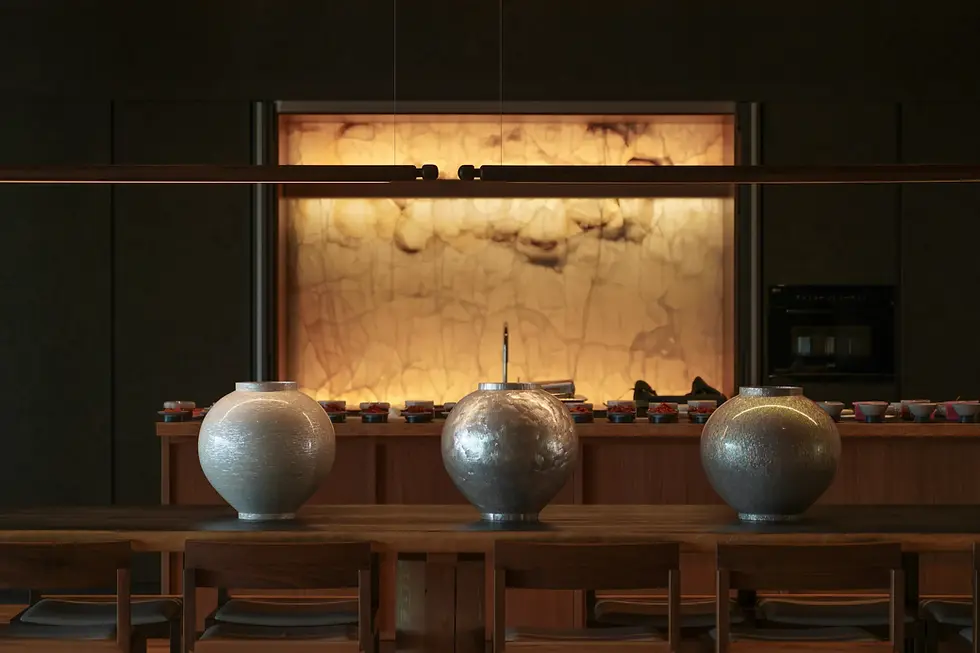
The Joseon moon jar is another fitting example of ‘geom-i-bul-ru, hwa-i-bul-chi’. It is minimally decorated, and its surface is rarely perfectly uniform. Yet its simple form never feels lacking.
Moon jars were made by joining two separately thrown hemispheres. During the process, the vessel might become subtly uneven or lean slightly to one side. Rather than appearing defective, these variations reveal the presence of the maker, the clay and the kiln.
Without elaborate decoration or intense colour, the moon jar still possesses a powerful presence. The depth of its white surface, its rounded form and its gentle irregularities come together to create a quiet sense of grandeur. It is modest without being plain, restrained without being ordinary.
Beauty in Relationship
To describe Korean aesthetics simply as ‘simple’ or ‘unadorned’ is to miss something important. Korean simplicity is not a lack of decoration, but a way in which objects and spaces become complete through their relationships with one another.
The beauty of a hanok does not reside in the building alone. It emerges through the relationship between the roofline and courtyard, the wall and the tree, the wooden frame and the light passing through the window. Likewise, the impression made by a palace depends not only on the scale of its buildings, but also on the relationship between architecture, courtyard, sky and landscape.
This sensibility also extends into Korean craft and everyday life. Ceramics were objects of appreciation, but they were also made to be used. A pavilion was a place from which to view the landscape, but also somewhere to meet, rest and spend time together.
"Korean beauty is expressed not only in the object itself, but in the relationship
between the object and its surroundings."

Different Ways of Seeing Beauty
Comparing Chinese, Japanese and Korean aesthetics is not a way of deciding which culture possesses the superior form of beauty. It is a starting point for understanding how different cultures shape and experience the aesthetic world.
Culture | Aesthetic tendency | How beauty is expressed |
China | Form and structure | Scale, proportion, order and monumentality |
Japan | Colour and ornament | Surface, texture and a carefully composed atmosphere |
Korea | Line and negative space | Naturalness, balance, relationship and depth |
This framework is not intended to reduce every work of art from each country to a single characteristic. China, Japan and Korea have influenced one another over centuries, and individual works may contain form, colour, line and ornament in equal measure.
Yet the comparison helps us understand why Korean aesthetics cannot be reduced to ‘simple beauty’. Korean beauty brings together restraint and naturalness, intimacy and dignity. Rather than overwhelming the viewer from a distance, it invites us to come closer—to notice material, time and the trace of the human hand.
The Roots of K-Culture
The lecture also offered an opportunity to reflect on how contemporary Korean culture—including K-pop, film and television—has grown from a much longer history of artistic and cultural expression. Contemporary K-culture does not simply reproduce tradition. It brings older sensibilities into conversation with new technologies, familiar emotions with contemporary forms, and inherited materials with fresh ways of seeing.
The vibrant rhythm and striking imagery associated with contemporary Korean culture may seem far removed from the restrained whiteness of a moon jar or the quiet proportions of a traditional courtyard. Yet the connection lies not in a fixed visual style, but in the ability to bring different elements together—to combine precision with vitality, structure with spontaneity, and innovation with a recognisable human touch.
In this sense, the principle of ‘geom-i-bul-ru, hwa-i-bul-chi’ remains relevant today. It is an approach to making that creates a strong impression with restraint, and that holds beauty, function, individuality and balance in the same frame.
Scenes from the Talk © mai.korea
mai.korea's Perspective
Through a lecture by You Hong-june, then Director of the National Museum of Korea, Korean aesthetics came into focus as more than a quiet or modest form of beauty. They emerged through a distinctive relationship between line and negative space, and through a balance in which nature and human intervention, technique and material, remain connected without one overpowering the other.
For mai.korea, ‘geom-i-bul-ru, hwa-i-bul-chi’ — “humble yet dignified, splendid yet not extravagant” — offers a useful way of thinking about Korean culture today.
Korean beauty does not always reveal everything at first glance. It often unfolds gradually, inviting a closer look and rewarding attention. The more closely we observe, the more we begin to sense the histories, materials, skills and human relationships held within it.
We want to explore these connections for readers in the UK: to look beyond familiar images of contemporary Korea while recognising how the past continues to shape the present. Through heritage, art, design, food, places and everyday experiences, we hope to share a Korea that is not only seen, but encountered and understood in its depth.
Editor W.
KOREAN
SOAS에서 다시 만난 한국의 미감
지난 10월 1일, 런던 SOAS University of London에서 유홍준 당시 국립중앙박물관장의 특별 강연 ‘Ancient Korean Culture & Architecture’가 열렸다. SOAS Alumni Lecture Theatre에서 진행된 이번 강연은 선사시대와 삼국시대의 문화에서 출발해 불교미술과 건축, 고려청자와 조선백자에 이르기까지 한국 문화유산의 형성과 흐름을 살펴보는 자리였다.
강연은 한국의 고대 문화와 건축을 주요 유적과 예술품, 불교 유산과 왕실 건축을 통해 폭넓게 조망했다. 고구려·백제·신라·가야의 물질문화, 고분벽화와 금관, 불교 사리장엄구와 조각, 석굴암과 불국사, 석탑과 산지 사찰의 전통이 차례로 소개됐다.
이날 강연에서 특히 인상적이었던 것은 한국의 미를 하나의 고립된 특징으로 설명하기보다, 동아시아의 문화적 맥락 안에서 살펴보았다는 점이다. 중국과 일본의 미감과 나란히 비교하는 과정에서 한국의 아름다움은 선과 여백, 자연과의 조화, 그리고 절제와 품위의 균형 속에서 더욱 선명하게 드러났다. 이를 통해 한국 문화유산은 과거의 유물이 아니라, 오늘날 ‘K’ 로 시작하는 한국의 문화와 감각을 이해하게 하는 살아 있는 출발점으로 다가왔다.
검이불루 화이불치
강연에서 한국미를 설명하는 핵심 표현으로 소개된 것은 ‘검이불루 화이불치(儉而不陋 華而不侈)’였다. 『삼국사기』 백제본기에는 온조왕 15년인 기원전 4년, 새 궁궐을 지은 모습을 두고 “검소하되 누추하지 않고, 화려하되 사치스럽지 않다”고 기록되어 있다.
SOAS의 강연 소개에서는 이 표현을 “humble yet not undignified, splendid yet not extravagant”라는 한국 예술과 건축의 미적 원리로 설명했다. 한국어의 소박하지만 초라하지 않고, 화려하지만 과시적이지 않은 것. 당시 국립중앙박물관장이었던 유홍준은 이러한 균형이 한국의 전통 건축과 미술 전반에 반복해서 나타나는 중요한 미적 원리라고 설명했다.
중국의 형태와 구조
동아시아의 미를 비교할 때 중국 미술에서는 형태와 구조의 힘이 두드러진다. 정교한 비례와 안정적인 형식, 장엄한 규모는 대상에 권위와 질서를 부여한다. 아름다움은 완성도 높은 형태와 분명한 중심, 기념비적인 존재감 속에서 드러난다.
한국의 문화와 예술 역시 중국과 긴밀하게 영향을 주고받으며 발전했지만, 그 미감은 같은 방식으로 머물지 않았다. 한국의 건축과 공예는 규모와 권위를 강조하기보다 주변 환경과의 관계, 재료의 성질, 사람이 실제로 경험하는 공간의 흐름을 중요하게 여기는 방향으로 발전했다.
그래서 한국의 형태는 완전히 닫힌 형식이라기보다 주변과 관계를 맺는 형식에 가깝다. 건축은 산과 하늘을 배경으로 삼고, 도자기는 흙과 불의 흔적을 받아들이며, 공간은 비어 있는 부분까지 포함해 완성된다.
일본의 색채와 장식
일본 미술에서는 색채와 장식, 재료의 표면을 다루는 감각이 중요한 역할을 한다. 색의 대비와 패턴, 광택과 질감은 사물에 강한 분위기와 시각적 집중력을 부여한다. 절제된 공간 안에서도 색과 장식이 정교하게 조율되며 하나의 미적 세계를 만든다.
한국의 미는 이와 달리 선과 여백, 자연스러운 흐름에서 더욱 강하게 드러난다. 여기서 말하는 선은 단순한 윤곽선이 아니다. 기와지붕의 곡선, 도자기의 둥근 몸체, 한옥의 창호와 마루, 산세를 따라 배치된 사찰의 구조처럼 공간과 사물 전체에 흐르는 움직임이다.
한국의 선은 완벽하게 계산된 기하학적 선보다 자연의 흐름에 가깝다. 약간의 비대칭과 흔들림, 손으로 만든 흔적은 결함이 아니라 생동감을 만든다. 유홍준이 강조한 ‘검이불루 화이불치’의 균형은 바로 이 선과 여백의 미로 이어지기 때문이다.
선과 여백의 아름다움
한국미의 특징은 자연과 인공을 대립시키지 않는 데 있다. 인간은 자연을 완전히 지배하거나 정복하기보다, 자연의 지형과 재료, 빛과 계절의 변화에 맞추어 공간과 사물을 만들었다.
강연에서 예시로 삼은 석굴암과 불국사는 이러한 관계를 잘 보여주는 사례다. 석굴암은 정교한 기술로 만들어졌지만, 인공적인 구조가 자연의 질서와 충돌하지 않도록 구성되었다. 불국사 역시 석탑과 전각, 계단과 마당이 주변 지형과 함께 하나의 공간 경험을 만든다.
이러한 한국적 미감에서 중요한 점은 기술을 과시하는 행위가 아니라는 점일 것이다. 오랜 숙련을 바탕으로 만들어졌지만, 결과물은 처음부터 그 자리에 있었던 것처럼 자연스럽게 느껴진다. 기술은 전면에 나서지 않고 재료와 형태, 공간의 조화를 돕는 조력자의 역할을 자처한다.
지난 이천 도자기 런던전시편에서 표현한 바와 같이 여백은 비어 있는 공간이 아니다. 전통건축에서 도 마당과 하늘, 담장 너머의 산과 건물 사이의 간격은 사람의 움직임과 자연의 변화를 받아들이는 장소가 된다.
달항아리의 균형
역시 조선의 달항아리는 ‘검이불루 화이불치’를 설명하기에 적합한 작품일 것이다. 달항아리는 장식이 많지 않고 표면도 완벽하게 균일하지 않다. 그러나 그 단순한 형태는 결코 빈약해 보이지 않는다.
달항아리는 위와 아래를 따로 빚어 붙이는 과정에서 미세하게 비뚤어지거나 한쪽으로 기울어진다. 완전한 원형에서 벗어난 이 차이는 결함이라기보다 사람의 손과 흙, 불의 흔적을 보여주는 요소가 된다.
화려한 문양이나 강한 색채 없이도 달항아리는 충분한 존재감을 갖는다. 흰색의 깊이와 둥근 형태, 표면의 미세한 변화가 어우러져 조용한 장엄함을 만든다. 검소하지만 누추하지 않고, 담백하지만 결코 평범하지 않은 아름다움이다.
한국의 아름다움은 관계 속에서
한국의 미를 ‘소박하다’고만 설명하면 중요한 부분을 놓치게 된다. 한국미의 소박함은 장식이 부족한 상태가 아니라, 사물과 공간이 서로의 관계 속에서 완성되는 방식에 가깝다.
한옥의 아름다움은 건물 하나의 외관에만 있지 않다. 처마와 마당, 담장과 나무, 창호를 통과하는 빛이 함께 어우러질 때 한옥의 미가 완성된다. 궁궐 역시 건물 자체의 규모보다 건물과 마당, 하늘과 주변 지형이 맺는 관계 속에서 깊은 인상을 남긴다.
이러한 미감은 한국의 공예와 생활문화에서도 이어진다. 도자기는 감상의 대상이면서 실제로 사용하는 그릇이었고, 정자는 경치를 바라보는 장소이면서 사람들이 만나고 쉬는 생활 공간이었다.
“한국의 아름다움은 대상 자체보다 대상과 주변 사이의 관계에서 표현된다.”
서로 다른 아름다움
중국·일본·한국의 미를 비교하는 일은 어느 나라의 미가 더 우수한지를 판단하기 위한 것이 아니다. 서로 다른 문화가 아름다움을 조직하고 경험하는 방식을 이해하기 위한 출발점이다.
구분 | 미적경향 | 아름다움이 드러나는 방식 |
중국 | 형태와 구조 | 규모, 비례, 질서 그리고 장엄함 |
일본 | 색채와 장식 | 표면, 질감 그리고 정교한 분위기 |
한국 | 선과 여백 | 자연스러움, 균형 그리고 관계와 깊이 |
이 구분은 각 나라의 모든 예술을 하나의 특징으로 규정하는 공식은 아님을 강조한다. 세 문화는 오랜 시간 서로 영향을 주고받았으며, 실제 작품 안에서는 형태와 색채, 선과 장식이 함께 나타난다.
그럼에도 이러한 비교는 한국의 미가 단순히 ‘소박한 아름다움’이 아니라는 점을 이해하게 한다. 한국의 미는 절제와 자연스러움, 친밀감과 품위를 함께 품는다. 멀리서 한눈에 압도하기보다 가까이 다가갈수록 재료와 시간, 사람의 손길을 느끼게 한다.
K-컬처의 뿌리
강연은 오늘날 세계가 주목하는 K-pop, 영화, 드라마와 같은 현대 한국문화가 오랜 역사와 예술적 전통 위에서 성장했다는 점도 생각하게 했다. 현대의 K-컬처는 전통을 그대로 재현하는 방식으로만 이어지는 것이 아니다. 오래된 미감과 새로운 기술, 익숙한 정서와 동시대적인 형식이 결합하면서 새로운; MZ용어로 ‘까리한’ 표현을 만들어낸다.
빠른 리듬과 강렬한 이미지로 대표되는 현대 한국문화에서도 한국미의 흔적을 찾을 수 있다. 중요한 것은 단순히 색이 절제되었는지, 형태가 소박한지에 있지 않다. 서로 다른 요소를 하나의 흐름 안에서 조화시키고, 정교하게 구성하면서도 생동감과 인간적인 흔적을 남기는 방식에 있다.
이 점에서 ‘검이불루 화이불치’는 과거의 문장이면서 오늘날에도 유효한 미학적 원칙이다. 최소한의 요소로 충분한 인상을 만들고, 아름다움과 기능, 개성과 절제를 함께 유지하는 태도이기 때문이다.
마이코리아의 시선
유홍준 당시 국립중앙박물관장의 강연을 통해 다시 바라본 한국의 미는 단순히 조용하고 소박한 아름다움이 아니었다. 그것은 중국의 형태와 구조, 일본의 색채와 장식과 구별되는 한국만의 선과 여백이며, 자연과 인간, 기술과 재료가 서로의 자리를 존중하는 균형이었다.
마이코리아가 지향하는 오늘날의 ‘검이불루 화이불치’, ‘humble yet not undignified, splendid yet not extravagant’
검소하지만 누추하지 않고, 화려하지만 사치스럽지 않은 것. 이 여덟 글자는 백제 궁궐의 모습을 설명하기 위해 기록되었지만, 오늘날 한국의 건축과 공예, 디자인과 문화 전반을 바라보는 하나의 기준으로도 읽을 수 있다.
한국의 아름다움은 한눈에 모든 것을 드러내기보다, 가까이 다가갈수록 더 많은 이야기를 보여준다. 앞으로도 마이코리아는 그 안에 담긴 역사와 기술, 자연과 생활의 관계를 함께 읽어내며, 한국 문화가 가진 깊이와 현재적 가능성을 영국 독자에게 전하고자 한다.