Meekyoung Shin: Sculpting Time
ART & CRAFT

Meekyoung Shin (South Korean Sculptor) studied Sculpture at Seoul National University and later at the Slade School of Fine Art, University College London. She currently works between Seoul and London. For more than three decades, Shin has explored themes of cultural translation, replication, and the passage of time through the unusual medium of soap.
At first glance, her works resemble classical sculptures or historical artefacts. Yet upon closer inspection, viewers are met not with marble or stone, but with the distinctive scent of soap. By working with a material that gradually erodes and loses its form over time, Shin challenges the notion of history and culture as fixed entities, instead presenting them as something continuously interpreted, transformed, and reimagined.
Cultural Translation: A Question That Began in London
Shin’s artistic practice took shape during her years in London. Living between cultures prompted her to reflect deeply on questions of identity and cultural difference. Seeing herself as someone positioned between two worlds, she became increasingly interested in the misunderstandings, distortions, and reinterpretations that occur when culture travels across borders.
A pivotal moment came while she was studying at the Slade School of Fine Art, when she witnessed the restoration of the neoclassical sculpture Venus at Her Bath displayed in the school's main building. The traces of time embedded within the weathered surface of the sculpture led her to consider the relationship between objects, history, and context. These reflections evolved into the concept of “Translation,” which would become the foundation of her long-running Translation series.

Soap became a central material within this body of work, serving not simply as a sculptural medium but as a metaphor for cultures and histories that are constantly reshaped by time and circumstance.
In 1998, shortly after graduating, Shin participated in an exhibition at the Hayward Gallery, presenting soap replicas of ancient Greek sculptures from the British Museum's collection. In 2004, she performed a live soap-sculpting project in the museum's Great Court. Through works such as Translation – Vase and Translation – Moon Jar, she gained international recognition for exploring how cultural heritage shifts in meaning as it moves between different geographical and cultural contexts.
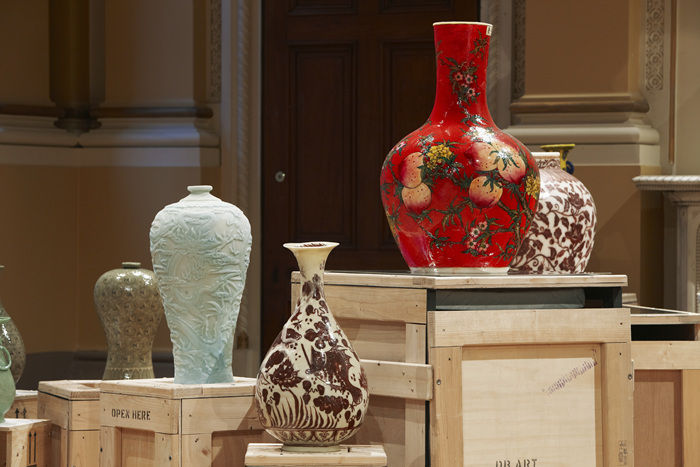
First presented at Asia House in London in 2006, Translation – Vase recreated Chinese blue-and-white porcelain in soap. Viewing these export ceramics as products of a form of “mis-translation”, Shin displayed the works on wooden shipping crates, highlighting the processes of movement, exchange, and reinterpretation through which culture travels.
In Translation – Moon Jar, she turned her attention to Korea’s iconic moon jars, questioning how Korean cultural heritage is viewed, interpreted, and displayed within Western museum contexts. Meanwhile, her Ghost Series reduced ceramics to their essential forms and translucent colour, stripping away decorative details to evoke artefacts detached from their original cultural contexts.

Together, these works moved beyond simple replication, offering a critical reflection on how museums construct meaning, authority, and historical value.
Beyong the Museum: Interventions in Public Space
From the mid-2000s onwards, Shin’s practice increasingly expanded beyond the museum.

Beginning in 2004, her Toilet Project placed soap sculptures in public washrooms, returning the material to its original functional environment. Visitors became active participants in the work, gradually wearing away the sculptures through everyday use. Identical forms acquired different meanings depending on where they were installed and who encountered them.

Another significant project, Written in Soap: A Plinth Project (2012–), involved recreating in soap a removed equestrian statue of the Duke of Cumberland and reinstalling it on an empty plinth in London’s Cavendish Square. By bringing a controversial monument back into public view, the work prompted debate about collective memory, public monuments, and the ways in which history is continually rewritten.
For Shin, these differing responses revealed that history is never fixed. Rather, it remains a living narrative, constantly reinterpreted according to place, time, and perspective. In this way, her work engages directly with broader debates surrounding heritage, monuments, and institutional authority that continue to shape public discourse in Britain today.
Connecting Seoul and London: Recent Practice

Over the past decade, Shin has continued to develop her practice across both Korea and the UK. Alongside museum exhibitions, she has expanded into public projects and site-specific installations, engaging increasingly diverse audiences.
In Korea, she has presented major exhibitions at institutions including Wooyang Museum of Contemporary Art, Arko Art Center, Coreana Museum of Art, and the Seoul Museum of Art. Among these, Celestial Whisper (2024–25) at the Buk-Seoul Museum of Art explored the boundaries between reality and imagination, materiality and immateriality, through the symbolic figure of the angel. Her recent practice has also expanded beyond soap to include materials such as ceramic, bronze, resin, and Jesmonite.

One of her most recent projects, Korean Classic: In Use (2026), exemplifies the continued evolution of her ideas. Recreating the plaster casts and classical sculptures familiar to generations of Korean art students in soap, Shin installed the works across a range of everyday spaces in London, including SOAS University of London, Delfina Foundation, Café Babka, Gaia Food & Drinks, and SOOM Restaurant.
Rather than existing as protected objects within a gallery, these sculptures continue to change through touch, use, and the passage of time. The works will be reunited in an exhibition at the Korean Cultural Centre UK in September 2026, carrying with them the traces, memories, and experiences accumulated at each location.
More than thirty years after first posing questions about cultural translation in London, Shin continues to explore how culture travels, how history is interpreted, and how time shapes both art and memory. Her work remains an ongoing investigation into the ways meaning is created, transformed, and preserved across generations and geographies.
Korean Cultural Centre UK Grand Buildings, 1 - 3 Strand, London WC2N 5BW SOAS University of London 10 Thornhaugh St, London WC1H 0XG Delfina Foundation 29-31 Catherine Place, London SW1E 6DY Café Babka 44 Great Russell St, London WC1B 3PA Gaia Food & Drinks 62 Great Russell St, London WC1B 3BG SOOM Restaurant |
Editor S.
KOREAN
시간을 조각하는 예술가, 신미경
신미경 작가는 서울대학교 미술대학과 동대학원에서 조소를 전공한 뒤 영국 런던대학교 슬레이드 미술대학(Slade School of Fine Art)에서 수학했다. 현재는 서울과 런던을 오가며 활동하고 있다. 지난 30여 년간 비누라는 독특한 재료를 통해 문화적 번역, 복제, 시간의 흐름이라는 주제를 탐구해 왔다.
그녀의 작업은 언뜻 보면 고전 조각이나 역사적 유물의 복제품처럼 보인다. 그러나 가까이 다가가면 관객은 대리석이 아닌 비누 특유의 향을 마주하게 된다. 작가는 시간이 지나며 닳고 형태를 잃는 비누의 물성을 통해 역사와 문화가 고정된 것이 아니라 끊임없이 해석되고 변화하는 존재임을 보여준다.
런던에서 시작된 문화적 번역
신미경의 작업 세계는 영국 유학 시절 본격적으로 형성되었다. 영국에 와서 생활하면서 문화적 차이와 정체성에 대한 고민을 깊이 하게 된 것이다. 스스로를 두 개의 문화 사이에 놓인 존재로 인식하기 시작한 작가는 문화가 이동하는 과정에서 발생하는 오해와 변형, 그리고 재해석의 과정에 주목하게 된다.
슬레이드 미술대학 재학 중 학교 본관에 전시된 신고전주의 조각상 <목욕하는 비너스>가 복원되는 과정을 지켜본 경험으로 시간의 흔적과 유물의 의미에 관심을 갖게 되었고, 이를 ‘문화적 번역(Translation)’이라는 개념으로 발전시켰다. 그렇게 시작된 <Translation> 시리즈는 오늘날까지 이어지는 그의 대표 연작이 되었다. 비누는 문화와 역사가 끊임없이 변화하고 재해석되는 과정을 드러내는 핵심 매체로 자리 잡았다.
1998년 헤이워드 갤러리 전시에 참여하며 대영박물관 소장 그리스 조각을 비누로 재현한 작업을 선보였고, 2004년에는 대영박물관 로비에서 비누 조각 퍼포먼스를 진행했다. 이후 <Translation – Vase>, <Translation – Moon Jar> 등의 작업을 통해 동서양 문화유산이 이동하고 해석되는 과정을 탐구하며 국제적인 주목을 받았다.
2006년 런던 아시아하우스(Asia House)에서 처음 공개된 <Translation – Vase> 시리즈는 중국 청화백자를 비누로 재현한 작업이다. 원래 유럽 수출을 위해 제작되었던 중국 도자기의 역사를 ‘왜곡된 번역’의 과정으로 바라본 작가는 비누 도자기를 운송용 목재 크레이트 위에 설치함으로써 문화의 이동과 해석의 과정을 시각화했다.
이어 선보인 <Translation – Moon Jar>에서는 한국의 달항아리를 비누로 재현하며 한국 문화유산이 서구 박물관 안에서 어떻게 읽히고 전시되는지 질문을 던졌다. 또한 <Ghost Series>에서는 도자기의 표면 장식을 제거하고 형태와 반투명한 색채만 남겨 문화적 맥락이 탈각된 유물의 상태를 표현했다.
이 시기의 작업들은 단순한 복제가 아니라, 박물관이 어떻게 유물을 만들어내고 권위를 부여하는지에 대한 비판적 성찰로 이어졌다.
박물관을 넘어 공공 공간으로
2000년대 중반 이후 신미경의 작업은 미술관을 넘어 공공 공간으로 확장되었다. 2004년부터 이어진 <Toilet Project>는 비누 조각을 본래 비누가 사용되는 공간인 화장실에 설치하는 프로젝트다. 관객은 손을 씻으며 작품을 만지고 마모시키게 되고, 그 과정 자체가 작품의 일부가 된다. 같은 형태의 비누 조각이라도 어느 국가, 어느 문화권, 어떤 사람들이 사용하는가에 따라 전혀 다른 역사와 의미를 갖게 된다.
2012년부터 진행된 <Written in Soap: A Plinth Project>는 작가의 대표적인 공공 프로젝트 중 하나다. 런던 캐번디시 스퀘어의 빈 좌대 위에 과거 철거된 컴버랜드 공작 기마상을 비누로 복원해 설치한 작업은 역사적 기억과 공공 기념물의 의미에 대한 논의를 불러일으켰다.
철거된 기념비를 다시 소환한 이 작업은 역사적 기억과 공공 기념물의 의미에 대한 논의를 불러일으켰다. 신미경은 이러한 상반된 반응 자체를 통해 역사란 고정된 사실이 아니라 장소와 시대에 따라 끊임없이 재해석되는 살아 있는 서사임을 보여주고자 했다. 이러한 작업들은 역사와 기념비, 그리고 박물관의 권위에 대한 질문을 던지며 영국 사회에서 지속적으로 논의되어 온 문화유산과 공공기념물에 대한 담론과도 연결된다.
서울과 런던을 잇는 현재
최근 10여 년 동안 신미경은 한국과 영국을 오가며 활발한 활동을 이어왔다. 미술관 전시뿐 아니라 공공 프로젝트와 도시 공간을 활용한 설치 작업까지 영역을 확장하며 보다 다양한 관객과 만나고 있다. 한국에서는 우양미술관, 아르코미술관, 코리아나미술관, 서울시립미술관 등에서 주요 전시를 개최했으며, 특히 2024~2025년 서울시립미술관 북서울미술관에서 열린 대규모 개인전 <Celestial Whisper>는 천사라는 존재를 통해 실재와 환상, 물질과 비물질의 경계를 탐구하며 새로운 작업 세계를 선보인 전시로 평가받았다. 또한 비누에 국한되지 않고 세라믹, 브론즈, 레진, 제스모나이트 등 다양한 재료를 탐구하며 조각의 가능성을 확장하고 있다.
런던에서 현재 진행 중인 <Korean Classic: In Use>는 그녀의 최근 행보를 가장 잘 보여주는 프로젝트라 할 수 있다. 한국 미술대학에서 익숙한 석고상과 고전 조각을 비누로 재현해 SOAS University of London, Delfina Foundation, Café Babka, Gaia Food & Drinks, SOOM Restaurant 등 런던의 다양한 공간에 설치했으며, 관객의 사용과 시간의 흐름에 따라 변화하는 과정을 작품의 일부로 제시한다.
이후 이 조각들은 2026년 9월 주영한국문화원 전시에서 다시 소개될 예정이지만, 처음 설치되었을 때의 모습 그대로 남아 있지는 않을 것이다. 각 장소에서 축적된 사용의 흔적과 일상의 경험을 품은 채 또 다른 이야기를 갖게 되기 때문이다.
30여 년 전 런던에서 시작된 신미경의 질문은 여전히 현재진행형이다.그녀의 작업은 문화와 역사가 어떻게 이동하고 번역되는지,그리고 시간이 예술과 기억에 어떤 의미를 부여하는지를 끊임없이 질문한다.
